
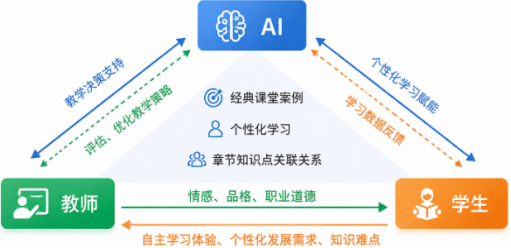
Objective: This study aimed to investigate the application effectiveness of artificial intelligence (AI)-supported teaching reform in toxicology courses and to provide practical insights for cultivating public health professionals under the background of emerging medical education transformation. Methods: A “teacher–AI–student” collaborative teaching framework was developed and implemented in toxicology education. The AI-assisted teaching system integrated a toxicology knowledge graph, virtual simulation laboratory, and toxicity prediction learning modules to support safety evaluation education. A total of 101 undergraduate students were enrolled in this teaching practice and were divided into a traditional teaching group (n=50) and an AI-assisted teaching group (n=51). Both groups received a 16-hour toxicology course. Learning interest, knowledge comprehension, experimental engagement, and overall course satisfaction were evaluated through questionnaire surveys, and the differences between the two groups were statistically analyzed.. Results: Compared with the traditional teaching group, students receiving AI-assisted instruction showed significantly improved performance in toxicological knowledge understanding, experimental participation, and course satisfaction (P<0.05). The integration of AI-based knowledge mapping and virtual reality (VR) simulation experiments enhanced students’ comprehension of complex toxicological mechanisms and safety evaluation procedures. Furthermore, the interactive learning environment promoted students’ autonomous learning behaviors and practical application abilities. Conclusion: AI-supported toxicology teaching provides an effective approach for addressing the limitations of conventional teaching methods, including the separation between theoretical knowledge and practical training and the restriction of experimental resources. The proposed teaching model may facilitate the digital transformation of medical education and contribute to the development of high-quality public health professionals with stronger analytical and practical competencies.
| Published in | Science Research (Volume 14, Issue 4) |
| DOI | 10.11648/j.sr.20261404.17 |
| Page(s) | 186-191 |
| Creative Commons |
This is an Open Access article, distributed under the terms of the Creative Commons Attribution 4.0 International License (http://creativecommons.org/licenses/by/4.0/), which permits unrestricted use, distribution and reproduction in any medium or format, provided the original work is properly cited. |
| Copyright |
Copyright © The Author(s), 2026. Published by Science Publishing Group |
Artificial Intelligence, Toxicology, Teaching Reform, Virtual Simulation, Medical Education
指标 | 传统教学组(n=50) | AI教学组(n=51) | P值 |
|---|---|---|---|
学习兴趣满意度 | 较低 | 较高 | <0.05 |
知识理解程度 | 一般 | 明显提高 | <0.05 |
实验参与度 | 一般 | 明显提高 | <0.05 |
课程总体满意度 | 一般 | 明显提高 | <0.05 |
| [1] | Wang J, Li J. The digital evolution in toxicology: pioneering computational education for emerging challenges [J]. BMC Medical Education, 2024, 24(1)1204-1204. |
| [2] | Schmierer S E.Modernizing toxicology: The importance of accessible NAM training. [J]. Toxicology letters, 2025, 40638-39. |
| [3] | Pasquale C, Pieranna C, Renata S.Advanced technologies in genomic toxicology: Current trend and future directions [J]. Current Opinion in Toxicology, 2024, 37100444-. |
| [4] | 中共中央, 国务院. 教育强国建设规划纲要(2024—2035年) [Z]. 2025. |
| [5] | 教育部等九部门. 关于加快推进教育数字化的意见 [Z]. 2025. |
| [6] | 李海斌, 徐光翠, 郑志, 等. 毒理学基础实验教学改革的探索与实践 [J]. 新乡医学院学报, 2017, 34(12): 74-76. |
| [7] | Gordon M, Daniel M, Ajiboye A, et al.A scoping review of artificial intelligence in medical education: BEME Guide No. 84. [J]. Medical teacher, 2024, 46(4)21-25. |
| [8] | Tozsin A, Ucmak H, Soyturk S, et al.The Role of Artificial Intelligence in Medical Education: A Systematic Review. [J]. Surgical innovation, 2024, 31(4)15533506241248239-15533506241248239. |
| [9] | Zhoumeng L, WeiChun C. Machine learning and artificial intelligence in toxicological sciences. [J]. Toxicological sciences: an official journal of the Society of Toxicology, 2022, 189(1)7-19. |
| [10] | Rincón H H E, Jimenez D, Aguilar C A L, et al.Mapping the use of artificial intelligence in medical education: a scoping review [J]. BMC Medical Education, 2025, 25(1)526-526. |
| [11] | Consoli S, Coletti P, Markov V P, et al.An epidemiological knowledge graph extracted from the World Health Organization's Disease Outbreak News.[J].Scientific data, 2025, 12(1)970. |
| [12] | Tripathi A, Alisha, Riya, Sriram K, et al. Artificial Intelligence and Machine Learning-Based Approaches for Genetic Damage Prediction [J]. Methods in Molecular Biology, 2026, 2986: 587-635. |
| [13] | OECD. OECD QSAR Toolbox User Manual [EB/OL]. |
| [14] | U.S. Environmental Protection Agency. CompTox Chemicals Dashboard User Guide [EB/OL]. |
| [15] | Feigerlova E, Hani H, Hothersall-Davies E. A Systematic Review of the Impact of Artificial Intelligence on Educational Outcomes in Health Professions Education [J]. BMC Medical Education, 2025, 25: 129. |
| [16] | 吴砥, 冯倩怡.人工智能时代的教育变革: 发展形势与现实路径 [J]. 华中师范大学学报(人文社会科学版), 2025, 64(06): 136-145. |
APA Style
Ke, W., Qian, D., Zhi, Z. (2026). Artificial Intelligence Enabled Reform of Vocational Competency Teaching in Toxicology Under Healthcare Reform. Science Research, 14(4), 186-191. https://doi.org/10.11648/j.sr.20261404.17
ACS Style
Ke, W.; Qian, D.; Zhi, Z. Artificial Intelligence Enabled Reform of Vocational Competency Teaching in Toxicology Under Healthcare Reform. Sci. Res. 2026, 14(4), 186-191. doi: 10.11648/j.sr.20261404.17
@article{10.11648/j.sr.20261404.17,
  author = {Wei Ke and Dai Qian and Zheng Zhi},
  title = {Artificial Intelligence Enabled Reform of Vocational Competency Teaching in Toxicology Under Healthcare Reform},
  journal = {Science Research},
  volume = {14},
  number = {4},
  pages = {186-191},
  doi = {10.11648/j.sr.20261404.17},
  url = {https://doi.org/10.11648/j.sr.20261404.17},
  eprint = {https://article.sciencepublishinggroup.com/pdf/10.11648.j.sr.20261404.17},
  abstract = {Objective: This study aimed to investigate the application effectiveness of artificial intelligence (AI)-supported teaching reform in toxicology courses and to provide practical insights for cultivating public health professionals under the background of emerging medical education transformation. Methods: A “teacher–AI–student” collaborative teaching framework was developed and implemented in toxicology education. The AI-assisted teaching system integrated a toxicology knowledge graph, virtual simulation laboratory, and toxicity prediction learning modules to support safety evaluation education. A total of 101 undergraduate students were enrolled in this teaching practice and were divided into a traditional teaching group (n=50) and an AI-assisted teaching group (n=51). Both groups received a 16-hour toxicology course. Learning interest, knowledge comprehension, experimental engagement, and overall course satisfaction were evaluated through questionnaire surveys, and the differences between the two groups were statistically analyzed.. Results: Compared with the traditional teaching group, students receiving AI-assisted instruction showed significantly improved performance in toxicological knowledge understanding, experimental participation, and course satisfaction (P<0.05). The integration of AI-based knowledge mapping and virtual reality (VR) simulation experiments enhanced students’ comprehension of complex toxicological mechanisms and safety evaluation procedures. Furthermore, the interactive learning environment promoted students’ autonomous learning behaviors and practical application abilities. Conclusion: AI-supported toxicology teaching provides an effective approach for addressing the limitations of conventional teaching methods, including the separation between theoretical knowledge and practical training and the restriction of experimental resources. The proposed teaching model may facilitate the digital transformation of medical education and contribute to the development of high-quality public health professionals with stronger analytical and practical competencies.},
 year = {2026}
}
TY  - JOUR
T1  - Artificial Intelligence Enabled Reform of Vocational Competency Teaching in Toxicology Under Healthcare Reform
AU  - Wei Ke
AU  - Dai Qian
AU  - Zheng Zhi
Y1  - 2026/08/13
PY  - 2026
N1  - https://doi.org/10.11648/j.sr.20261404.17
DO  - 10.11648/j.sr.20261404.17
T2  - Science Research
JF  - Science Research
JO  - Science Research
SP  - 186
EP  - 191
PB  - Science Publishing Group
SN  - 2329-0927
UR  - https://doi.org/10.11648/j.sr.20261404.17
AB  - Objective: This study aimed to investigate the application effectiveness of artificial intelligence (AI)-supported teaching reform in toxicology courses and to provide practical insights for cultivating public health professionals under the background of emerging medical education transformation. Methods: A “teacher–AI–student” collaborative teaching framework was developed and implemented in toxicology education. The AI-assisted teaching system integrated a toxicology knowledge graph, virtual simulation laboratory, and toxicity prediction learning modules to support safety evaluation education. A total of 101 undergraduate students were enrolled in this teaching practice and were divided into a traditional teaching group (n=50) and an AI-assisted teaching group (n=51). Both groups received a 16-hour toxicology course. Learning interest, knowledge comprehension, experimental engagement, and overall course satisfaction were evaluated through questionnaire surveys, and the differences between the two groups were statistically analyzed.. Results: Compared with the traditional teaching group, students receiving AI-assisted instruction showed significantly improved performance in toxicological knowledge understanding, experimental participation, and course satisfaction (P<0.05). The integration of AI-based knowledge mapping and virtual reality (VR) simulation experiments enhanced students’ comprehension of complex toxicological mechanisms and safety evaluation procedures. Furthermore, the interactive learning environment promoted students’ autonomous learning behaviors and practical application abilities. Conclusion: AI-supported toxicology teaching provides an effective approach for addressing the limitations of conventional teaching methods, including the separation between theoretical knowledge and practical training and the restriction of experimental resources. The proposed teaching model may facilitate the digital transformation of medical education and contribute to the development of high-quality public health professionals with stronger analytical and practical competencies.
VL  - 14
IS  - 4
ER  -
School of Public Health, Henan Medical University, Xinxiang, China; Xinxiang Key Laboratory of Applied Microbial Technology, Xinxiang, China
School of Public Health, Henan Medical University, Xinxiang, China; Xinxiang Key Laboratory of Applied Microbial Technology, Xinxiang, China
School of Public Health, Henan Medical University, Xinxiang, China; Xinxiang Key Laboratory of Applied Microbial Technology, Xinxiang, China; The First Affiliated Hospital of Henan Medical University, Weihui, China

Information


 Share This Article
 Twitter
 Linked In
 Facebook
 Copy
Copy Download