
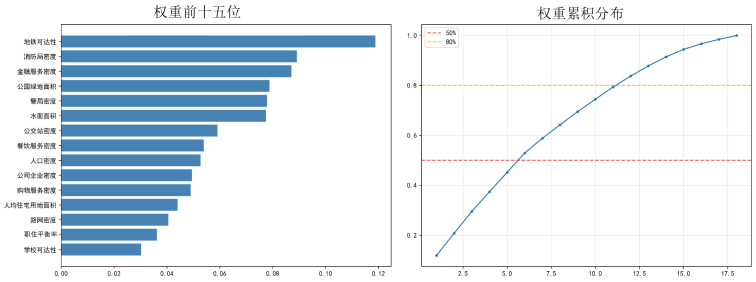
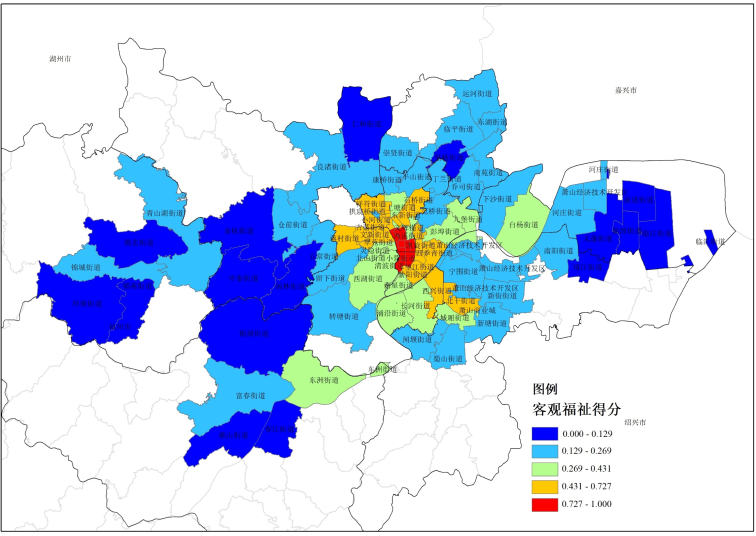
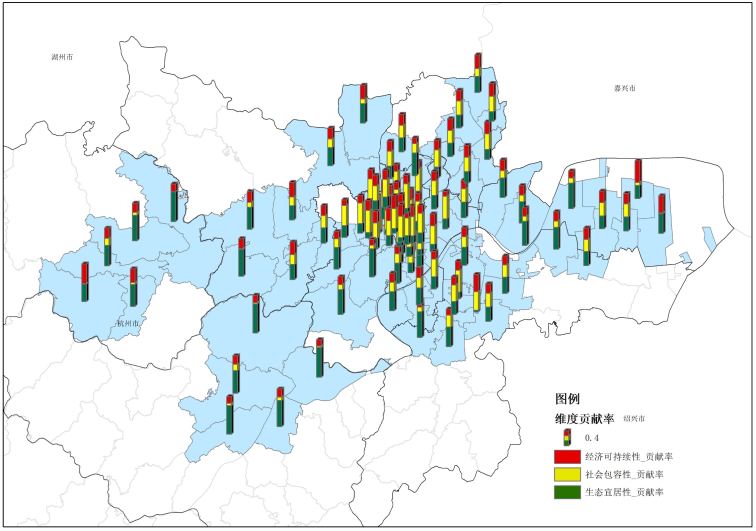
Spatial differentiation of residential well-being is an important dimension for measuring the balance of urban internal development. Existing studies have largely focused on macro-level comparisons between cities, with relatively insufficient attention to fine-scale measurement and spatial patterns at the street level within cities. Taking 86 sub-districts in the main urban area of Hangzhou as the study area, this paper adopts an “economy-society-ecology” three-dimensional analytical framework and integrates multi-source spatiotemporal big data including POI, mobile signaling, road networks, air quality monitoring, and Weibo check‑in texts. Using the entropy weight method and sentiment analysis, the study measures the level of residential well-being at the street scale and reveals its spatial differentiation patterns. The results show that metro coverage, fire station density, and financial service density are core indicators that differentiate street‑level well‑being. Residential well-being exhibits a significant core-periphery gradient decreasing pattern, with high‑scoring sub‑districts highly concentrated in the city center and low scores widely distributed in peripheral areas. The ecological livability dimension presents an inverse pattern of “low in the core, high in the periphery”, revealing a dilemma of “ecology without services”. The social inclusiveness dimension is highly concentrated in the core area, while the economic sustainability dimension contributes the least. A significant positive correlation is found between objective and subjective well‑being, validating the measurement results. This study provides empirical evidence for refined diagnosis and targeted governance of well‑being within megacities.
| Published in | Science Research (Volume 14, Issue 4) |
| DOI | 10.11648/j.sr.20261404.16 |
| Page(s) | 177-185 |
| Creative Commons |
This is an Open Access article, distributed under the terms of the Creative Commons Attribution 4.0 International License (http://creativecommons.org/licenses/by/4.0/), which permits unrestricted use, distribution and reproduction in any medium or format, provided the original work is properly cited. |
| Copyright |
Copyright © The Author(s), 2026. Published by Science Publishing Group |
Residential Well-being, Street Scale, Multi-source Data, Entropy Weight Method, Spatial Differentiation, Hangzhou
一级 | 二级 | 三级 | 方向 |
|---|---|---|---|
经济可持续性(A) | 就业环境(A1) | A11:职住平衡率 | + |
A12:平均通勤距离 | - | ||
集聚规模(A2) | A21:常住人口密度 | + | |
A31:金融服务密度 | + | ||
经济活力(A3) | A32:公司企业密度 | + | |
社会包容性(B) | 教育覆盖(B1) | B11:学校覆盖率 | + |
医疗覆盖(B2) | B21:医疗服务覆盖率 | + | |
设施覆盖(B3) | B31:餐饮服务密度 | + | |
B32:购物服务密度 | + | ||
交通覆盖(B4) | B41:地铁覆盖率 | + | |
B42:路网密度 | + | ||
B43:公交站密度 | + | ||
生态宜居性(C) | 环境质量(C1) | C11:AQI指数 | - |
蓝绿空间(C2) | C21:公园绿地面积 | + | |
C22:水系面积 | + | ||
住房条件(C3) | C31:人均住宅用地面积 | + | |
安全支持(C4) | C41:警局密度 | + | |
C42:消防局密度 | + |
得分区间 | 街道数量 | 占比 | 分布区域 |
|---|---|---|---|
0.68~1.00 | 8 | 9.3% | 老城区核心(上城区、拱墅区) |
0.46~0.68 | 10 | 11.6% | 核心区外围成熟区域 |
0.32~0.46 | 12 | 14.0% | 近郊区 |
0.17~0.32 | 21 | 24.4% | 外围街道 |
0.00~0.17 | 35 | 40.7% | 边缘区域 |
维度 | 平均贡献率 | 空间格局 | 核心特征得分 |
|---|---|---|---|
生态宜居性 | 47.0% | 核心区低、外围高 | 逆向格局,“有生态、缺服务” |
社会包容性 | 33.6% | 高度集中于核心区 | 核心区饱和、外围区短缺 |
经济可持续性 | 19.4% | 核心区高、外围低 | 宏观优势下沉失效 |
文本内容 | 积极概率 | 极性 | 情感词 |
|---|---|---|---|
示例1:今天杭州天气真好,心情特别愉快!. | 0.953 | positive | ['特别','愉快'] |
示例2:工作压力太大了,有点不开心。. | 0.225 | negative | ['压力太大','不开心'] |
示例3:这里是杭州第一花鸟市场。 | 0.552 | neutral | - |
相关系数 | 数值 | p值 |
|---|---|---|
皮尔逊 r | 0.545 | 0.009 |
| [1] | Dong G, Zhang Z, Zhang H, et al. Geographical match of objective and subjective measures of well-being at an intra-city scale [J]. Applied Geography, 2024, 167: 103290. |
| [2] | 湛东升, 汪子晨, 张文忠, 等. 多尺度城市人居环境感知对居民幸福感的影响——基于“四好”建设理念与城市体检数据的分析 [J]. 城市规划, 2025, 49(06): 4-15+110. |
| [3] | 朱媛媛, 杨千龙, 朱晓华, 王蕾. 中国城乡居民福祉水平演变及影响因素 [J]. 地理学报, 2025, 08(80): 2109-2127. |
| [4] | Wang S, Zou J. The impact of smart cities on residents’ well-being: Based on quasi-natural experiments & spatial spillover effects analysis [J]. Sustainable Cities and Society, 2025, 130: 106565. |
| [5] | Wang M, Zhou T. Does smart city implementation improve the subjective quality of life? Evidence from China [J]. Technology in Society, 2023, 72: 102161. |
| [6] | Nations U. Human development report 2023-24 [R]. Human Development Reports, 2024. |
| [7] | Kubiszewski I, Costanza R, Franco C, et al. Beyond GDP: Measuring and achieving global genuine progress [J]. Ecological Economics, 2013, 93: 57-68. |
| [8] | Senlier N, Yildiz R, Aktas E D. A perception survey for the evaluation of urban quality of life in Kocaeli and a comparison of the life satisfaction with the European cities [J]. Social Indicators Research, 2009, 94(2): 213-226. |
| [9] | Pereira C, Gonçalves H, Sequeira T. Determinants of human well-being [J]. arXiv: 2401. 17047. |
| [10] | Mouratidis K. Urban planning and quality of life: A review of pathways linking the built environment to subjective well-being [J]. Cities, 2021, 115: 103229. |
| [11] | 张志鹏. 基于空间多尺度统计模型的居民福祉研究 [D]. 河南大学, 2023. |
| [12] | 张志鹏, 董冠鹏, 王相彪, 等. 精细尺度下郑州市城市居民福祉的测度——基于主客观比较的视角 [J]. 地域研究与开发, 2024, 43(03): 83-89+96. |
| [13] | 郭瑞斌, 薛东前, 暴向平, 等. 西安市主城区客观生活质量空间格局研究 [J]. 人文地理, 2015, 30(05): 43-48. |
| [14] | 李兆中, 甄峰. 多源数据结合的城市生活空间质量评价——以南京为例 [J]. 人文地理, 2019, 34(06): 53-61. |
| [15] | 贺宏斌. 基于时空大数据的城市人居环境愉悦度研究 [D]. 云南大学, 2023. |
| [16] | 潘秋玲, 王兴中. 城市生活质量空间评价研究——以西安市为例 [J]. 人文地理, 1997, (02): 33-41. |
| [17] | 王圣云, 罗玉婷, 韩亚杰, 等. 中国人类福祉地区差距演变及其影响因素——基于人类发展指数(HDI)的分析 [J]. 地理科学进展, 2018, 37(8): 1150-1158. |
| [18] | Okulicz-Kozaryn A, Valente R R. Livability and subjective well-being across European cities [J]. Applied Research in Quality of Life, 2019, 14(1): 197-220. |
| [19] | Medvedev O N, Landhuis C E. Exploring constructs of well-being, happiness and quality of life [J]. PeerJ, 2018, 6: e4903. |
| [20] | Ge J, Hokao K. Residential environment index system and evaluation model established by subjective and objective methods [J]. Journal of Zhejiang University-Science A, 2004, 5(9): 1028-1034. |
| [21] | Zhou Q, Xu Y, Yang L, et al. Attitudes of the public and medical professionals toward nurse prescribing: A text-mining study based on social medias [J]. International Journal of Nursing Sciences, 2024, 11(1): 99-105. |
| [22] | Cheng Y, Zhang J, Wei W, et al. Effects of urban parks on residents’ expressed happiness before and during the COVID-19 pandemic [J]. Landscape and Urban Planning, 2021, 212: 104118. |
| [23] | Wang J, Fan Y, Palacios J, et al. Global evidence of expressed sentiment alterations during the COVID-19 pandemic [J]. Nature Human Behaviour, 2022, 6(3): 349-358. |
APA Style
Penghui, Z. (2026). Measuring Residential Well-being and Its Spatial Differentiation at the Street Scale in Hangzhou Based on Multi-source Data. Science Research, 14(4), 177-185. https://doi.org/10.11648/j.sr.20261404.16
ACS Style
Penghui, Z. Measuring Residential Well-being and Its Spatial Differentiation at the Street Scale in Hangzhou Based on Multi-source Data. Sci. Res. 2026, 14(4), 177-185. doi: 10.11648/j.sr.20261404.16
@article{10.11648/j.sr.20261404.16,
  author = {Zhu Penghui},
  title = {Measuring Residential Well-being and Its Spatial Differentiation at the Street Scale in Hangzhou Based on Multi-source Data},
  journal = {Science Research},
  volume = {14},
  number = {4},
  pages = {177-185},
  doi = {10.11648/j.sr.20261404.16},
  url = {https://doi.org/10.11648/j.sr.20261404.16},
  eprint = {https://article.sciencepublishinggroup.com/pdf/10.11648.j.sr.20261404.16},
  abstract = {Spatial differentiation of residential well-being is an important dimension for measuring the balance of urban internal development. Existing studies have largely focused on macro-level comparisons between cities, with relatively insufficient attention to fine-scale measurement and spatial patterns at the street level within cities. Taking 86 sub-districts in the main urban area of Hangzhou as the study area, this paper adopts an “economy-society-ecology” three-dimensional analytical framework and integrates multi-source spatiotemporal big data including POI, mobile signaling, road networks, air quality monitoring, and Weibo check‑in texts. Using the entropy weight method and sentiment analysis, the study measures the level of residential well-being at the street scale and reveals its spatial differentiation patterns. The results show that metro coverage, fire station density, and financial service density are core indicators that differentiate street‑level well‑being. Residential well-being exhibits a significant core-periphery gradient decreasing pattern, with high‑scoring sub‑districts highly concentrated in the city center and low scores widely distributed in peripheral areas. The ecological livability dimension presents an inverse pattern of “low in the core, high in the periphery”, revealing a dilemma of “ecology without services”. The social inclusiveness dimension is highly concentrated in the core area, while the economic sustainability dimension contributes the least. A significant positive correlation is found between objective and subjective well‑being, validating the measurement results. This study provides empirical evidence for refined diagnosis and targeted governance of well‑being within megacities.},
 year = {2026}
}
TY  - JOUR
T1  - Measuring Residential Well-being and Its Spatial Differentiation at the Street Scale in Hangzhou Based on Multi-source Data
AU  - Zhu Penghui
Y1  - 2026/08/13
PY  - 2026
N1  - https://doi.org/10.11648/j.sr.20261404.16
DO  - 10.11648/j.sr.20261404.16
T2  - Science Research
JF  - Science Research
JO  - Science Research
SP  - 177
EP  - 185
PB  - Science Publishing Group
SN  - 2329-0927
UR  - https://doi.org/10.11648/j.sr.20261404.16
AB  - Spatial differentiation of residential well-being is an important dimension for measuring the balance of urban internal development. Existing studies have largely focused on macro-level comparisons between cities, with relatively insufficient attention to fine-scale measurement and spatial patterns at the street level within cities. Taking 86 sub-districts in the main urban area of Hangzhou as the study area, this paper adopts an “economy-society-ecology” three-dimensional analytical framework and integrates multi-source spatiotemporal big data including POI, mobile signaling, road networks, air quality monitoring, and Weibo check‑in texts. Using the entropy weight method and sentiment analysis, the study measures the level of residential well-being at the street scale and reveals its spatial differentiation patterns. The results show that metro coverage, fire station density, and financial service density are core indicators that differentiate street‑level well‑being. Residential well-being exhibits a significant core-periphery gradient decreasing pattern, with high‑scoring sub‑districts highly concentrated in the city center and low scores widely distributed in peripheral areas. The ecological livability dimension presents an inverse pattern of “low in the core, high in the periphery”, revealing a dilemma of “ecology without services”. The social inclusiveness dimension is highly concentrated in the core area, while the economic sustainability dimension contributes the least. A significant positive correlation is found between objective and subjective well‑being, validating the measurement results. This study provides empirical evidence for refined diagnosis and targeted governance of well‑being within megacities.
VL  - 14
IS  - 4
ER  -
School of Design and Architecture, Zhejiang University of Technology, Hangzhou, China

Information



 Share This Article
 Twitter
 Linked In
 Facebook
 Copy
Copy Download